That moment when a smell settles into the hallway and you realise something has died in the wall is not a pleasant one. You cannot see it, you cannot reach it, and every day it gets worse. We do this work every week across Newport, and there is nothing about your situation we have not walked into before.
Body mass is what separates a rat job from every other rodent job. A mature roof rat or Norway rat weighs between 250 and 500 grams, which is enough tissue to keep decomposing for three to five weeks inside a warm cavity. The smell is different too. Where a mouse is musky and sour, a rat produces a dense, sweetish, sulphurous stench that soaks into fabric and carpet and cannot be covered up with anything you buy at the supermarket. Households here routinely tell us they have simply stopped using a room, and in older terraces the smell often crosses into the neighbour’s place through a shared wall cavity.
Rats die where they travel, and they travel inside wall voids and subfloors. An animal moving between the roof space and a food source in the kitchen will drop down a stud bay, and if it has taken bait or been injured it often does not make it back up. The carcass lodges on a nogging, on top of insulation halfway down the wall, or on the bottom plate at floor level. In the suspended timber floor homes that are so common around Newport, it dies on a bearer or in the soil underneath, and the odour rises through floorboard gaps and service penetrations. That upward travel is also how fast a dead animal smell spreads through a house, which is why the room you notice first is rarely the room above the rat.
The trick in dead rat removal is pinpointing before cutting. Guesswork means several holes, wasted plaster, and an odour that carries on because the actual carcass was sitting 400 millimetres to the left. Our technicians run a structured odour gradient across the wall face, cross reference it against a detection sweep that reads decomposition moisture as a cool patch inside a warmer stud bay, then confirm it visually through a pilot hole before a single cut is made. We read the grease trails too, because those dark polished smears map the animal’s route and usually lead straight back to the hole it came in through.
Tell us where the smell is worst and we will call back with a time and a quote.
Most people call us once the smell has become impossible to live with, but a dead rat announces itself well before that point. Catching it early is the difference between a contained removal and a job that involves replacing insulation and repainting a ceiling.
Mice smell musky and sour. A rat is denser and sweeter, driven by hydrogen sulphide and methanethiol, and it clings to curtains, carpet and clothing. Most people describe it as impossible to ignore and impossible to mask.
A rat carries enough body mass to produce real fluid volume. When it comes through plaster you get a spreading wet shadow first, then a rust or yellow brown stain on a ceiling, cornice or wall that keeps growing.
Big metallic green or blue flies gathering on a single windowsill, or small pale maggots appearing at a skirting board or downlight, means a carcass is decomposing directly above or behind that spot.
A rat is too heavy to be shifted, so the odour stays anchored to one wall or one section of floor. If you can walk two metres away and lose the smell almost entirely, you have found the stud bay.
Rats have oily fur and rub along the same routes, leaving dark polished smears on rafters, pipes and wall plates. Those trails, plus chewed cable insulation or gnawed timber, tell us where the animal travelled and where it got in.
If the smell is bearable at 7am and unbearable by 4pm, that is decomposition accelerating in a hot roof or wall cavity. Warm weather can take a rat job from unpleasant to unliveable in a single afternoon.
Plenty of trades will tell you to open a window and wait it out. We turn up with the equipment to find the animal and the chemistry to clean up after it, and we quote the whole thing as one price.
Rat odour peaks fast and does not wait for a weekday. Our Newport phones are answered around the clock and a technician is dispatched, not booked in for next week.
Structured odour mapping and pilot hole checks find the carcass first. That is the difference between one neat access hole and a wall full of exploratory damage.
You hear the figure before anything is opened, and it includes the clean up. The number does not move unless the scope genuinely changes and you approve it first.
Antimicrobial treatment and enzyme deodorising are part of every dead rat removal. Pulling the body out and leaving the contaminated substrate behind just books you a second callout.
No signwriting on our vans. That matters for cafes, retail tenancies and rental properties where a branded truck out front creates a second problem of its own.
Crews who already know how the terraces, weatherboards and apartment conversions around Newport are framed, which means less searching and less cutting.
Three stages, in this order, every time. Nothing gets opened before you have seen the price, and nothing gets closed up before the cavity has been treated.
Cutting holes to chase a smell is guesswork with a repair bill attached, so we do not do it. A technician walks the property mapping odour intensity at three heights along each suspect wall, then brings in detection equipment that reads decomposition moisture as a temperature anomaly inside the stud bay. A check through a twelve millimetre pilot hole confirms it visually. If you would rather narrow it down yourself first, our guide to identifying what died in your property covers the same signs.
Only once we can point at the rat do we talk about access, and only then do we give you a fixed price. In most Newport jobs that means one opening no bigger than a power point, patched cleanly on the way out.
The carcass, any nesting material and the contaminated debris around it come out in sealed double bagged containment and leave the property with us, disposed of through channels approved under Victoria environmental health requirements. That part takes minutes. Skipping what follows is why the dead animal smell comes back after DIY removal.
What takes longer, and what actually solves the problem, is everything the rat left behind. Fat and fluid soak into plaster, framing and insulation, and the odour compounds bond to every porous surface within reach. We treat those surfaces with hospital grade antimicrobials, cut out and replace insulation that cannot be salvaged, and run bio-enzymatic deodorisers that digest the decay compounds rather than perfume over them. Where the fluids have already marked the ceiling below, brown ceiling stains and what they mean explains what can be sealed and what has to be replaced.
Rats are habitual. They use the same greased runs generation after generation, which is why the same wall cavity can produce a second carcass six months later. Before we leave, we trace the trails back to the gap that let the animal in, whether that is a broken air brick, an unsealed pipe penetration, a lifted tile or a torn subfloor screen. Where the entry is higher up, our homeowner's guide to a dead animal in your roof sets out what to check along the roof line.
You get that written up with photographs and a sensible proofing order. We will not seal an active run on the same visit, because closing a hole while rats are still inside just leaves you another carcass in the cavity. Once the activity has stopped, the proofing can be done safely.
Most of our work is ordinary homes across Newport where a rat has died somewhere nobody can reach. These are the spots we find them:
A rat in a family home spreads odour through the whole house within days, and it tends to be worst in the rooms you use most. Same day attendance keeps the disruption to a single visit, and you get the house back that afternoon rather than living around it for another week. In warm weather that window is shorter again, which is why dead animal smells get worse in summer.
Same-Day Response
Emergency crews reach Newport homes quickly
Odour elimination and decontamination included
No hidden fees, firm estimate before we start
A hands-on team focused on safe, thorough work
A rat odour in a trading business is a revenue problem as much as a hygiene one. We attend these sites discreetly, in unmarked vehicles, and around your hours where that helps:
For food businesses in particular, speed and documentation both matter. You get the carcass out, the area decontaminated, and a written record of what was found and what was treated, which is exactly what a council inspector or a head office audit file wants to see.
Fast Business Response
A team handling commercial carcass recovery every week
Discreet unmarked attendance outside trading hours
Full documentation for health and safety records
Scheduled monitoring for sites with recurring activity
Nobody can quote a dead rat job properly over the phone without knowing where the animal is, so here is what actually moves the number. You get a firm figure on site, before anything is opened, and the clean up is inside it.
A juvenile rat in an accessible spot is a quick job. A mature Norway rat that has been decomposing for a fortnight means more fluid, more contaminated material and more treatment.
A carcass reachable from a roof manhole is straightforward. One lodged halfway down a stud bay behind tiled bathroom wall, in a tight subfloor, or in a second storey cavity takes longer and needs more care.
Business hours are the usual rate. Genuine after hours, weekend and public holiday attendance carries a call out loading, which we tell you about on the phone rather than on the invoice.
A rat found in the first few days is a contained job. Weeks in, the fluids have travelled into plaster, timber and insulation, and the sanitising and deodorising scope grows accordingly.
Cutting an access panel in gyprock and patching it cleanly is different work to lifting a few roof tiles. Where the wall has to be opened, the making good is quoted with the job.
Antimicrobial treatment, enzyme deodorising, saturated insulation removal and hydroxyl treatment for long standing odour all scale with how much material the carcass contaminated.
Ring us and describe the smell. We will tell you what we think it is, what the likely scope looks like, and what it takes to confirm it. No obligation, and no charge for the conversation.
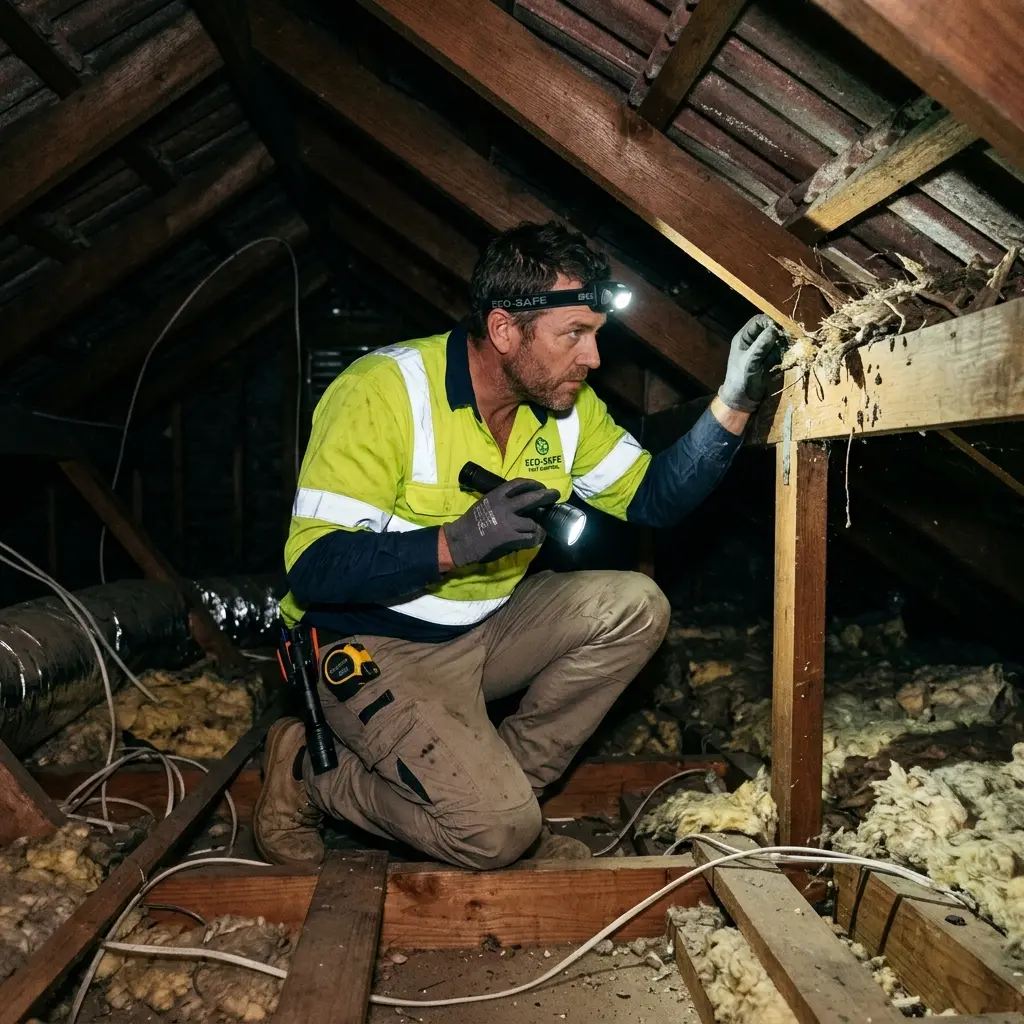
When a smell appears and you cannot place it, waiting is the expensive option. Our locally based crews hold same day inspection availability right across Newport and the surrounding suburbs, and we take emergency calls at any hour. A technician arrives, maps the odour, scans the suspect cavities and tells you exactly what you are dealing with.
Delay is what turns a straightforward dead rat removal into a restoration job. Fluids keep travelling into framing and plaster, secondary pests arrive, and the odour bonds deeper into every porous surface within reach. Booking on day three costs less and leaves less behind than booking on day fifteen, and that is true almost without exception. Our guide to how much dead animal removal costs in Melbourne sets out every factor that moves the number.
If it turns out the smell is not an animal at all, we will say so. A blocked drain, a dead possum in the roof rather than a rat in the wall, or a damp problem are all things we would rather identify honestly than treat as a rat job you did not need. If the noises sounded heavier than a rat, rat or possum: how to tell will help you work out which you have.
These are the calls that go to the front of the queue. If any of them describe your Newport property, ring us rather than booking online.
We provide dead rat removal across Newport and every surrounding suburb, with crews based locally so less of the day is spent driving to you.
Need immediate Dead Rat Removal? Our emergency team is available across all suburbs.
Call Emergency LineOur Newport crew also covers the suburbs right next door, so dead rat removal in any of these is the same short drive.
Guides & Insights
Reading That Saves You A Callout
Practical explanations of what you are smelling, what it is likely to cost and what to do first in Newport.
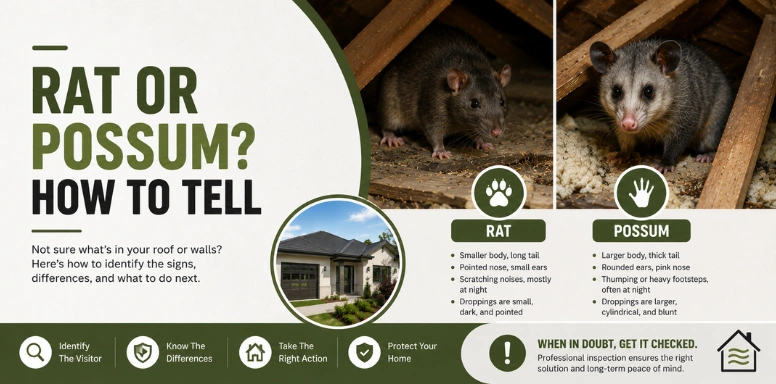
The two jobs differ in scale, cost and the rules that apply. You can usually tell them apart from evidence you have already noticed without realising it.
Read the guide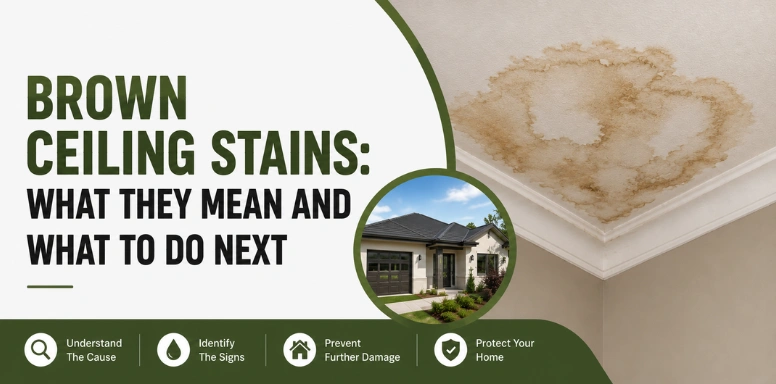
Most people assume a roof leak. If the mark keeps growing through a dry fortnight, it is not. Here is how to read a ceiling stain and what a proper repair involves.
Read the guide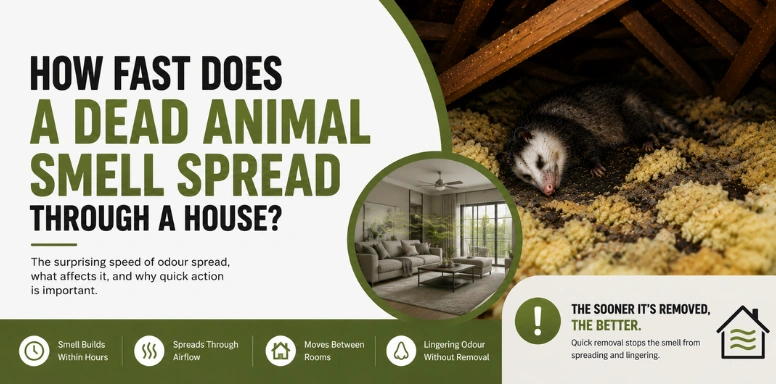
By day four it seems to be everywhere and people assume there must be more than one animal. Usually there is not. Here is how the odour actually moves.
Read the guideThe things Newport customers ask us before they book a dead rat removal.
Do Not Wait for a Rat to Dry Out. It Will Not.
Every extra day the fluids move further into your framing and plaster, and the stain gets harder to stop. One phone call gets a technician to your door with the detection gear to find it and the equipment to clean up properly afterwards.
6:00 AM - 11:30 PM, 7 Days a Week for Newport, VIC 3015 and every surrounding suburb.